The most expensive mistakes in tech history, and the lesson each one teaches
A missing symbol that destroyed a rocket. A typo that took down a chunk of the internet. A bank that paid off a $900 million loan three years early by ticking the wrong box. Ten of the costliest mistakes in tech history, on one timeline, with the lesson every IT team can take from each.
On this page
Most disasters in tech don't start with something dramatic. They start with something small: a symbol left out of an equation, one wrong input to a routine command, a setting nobody double-checked. What makes them expensive is everything that let the small mistake through.
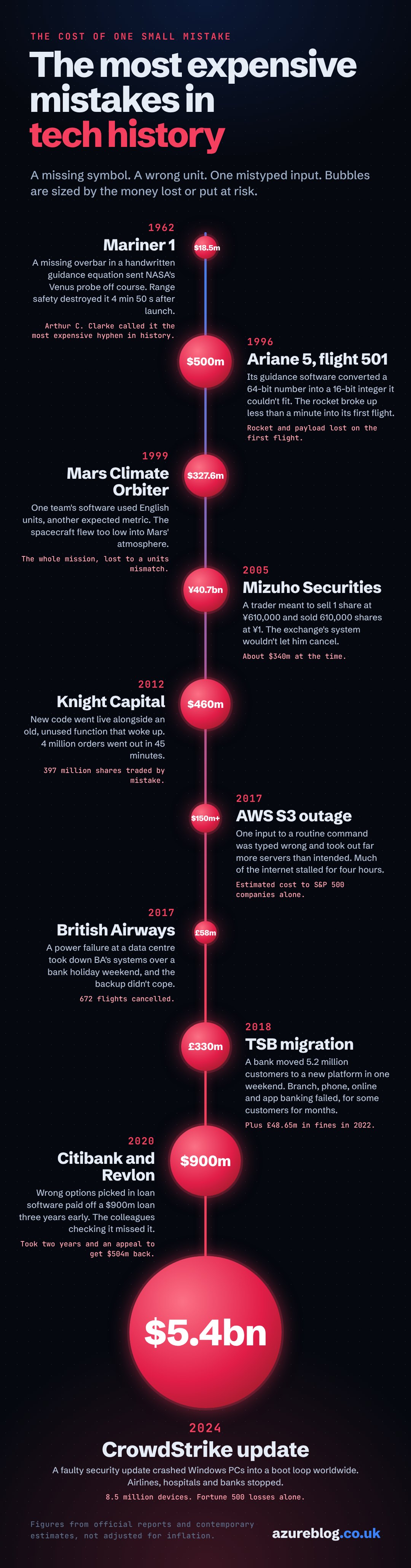
Here are ten of the costliest, from a rocket in 1962 to the update that crashed 8.5 million Windows PCs in 2024. The bubbles are sized by the money lost or put at risk.
Ten mistakes, and the lesson in each
Select any of them to see what happened and what it teaches.
1962 · Mariner 1 · $18.5 million
What happened: NASA's first Venus probe veered off course minutes after launch, and the range safety officer destroyed it 4 minutes 50 seconds into the flight. The cause was a missing overbar on an "R" in a handwritten guidance equation. Without it, the ground computer misread the rocket's movement and sent "corrections" it didn't need. Arthur C. Clarke later called it "the most expensive hyphen in history".
The lesson: the step where something written by a human becomes something run by a machine is where errors hide. Treat that hand-off, whether it's a spec becoming code or a change request becoming a script, as something to review, not just transcribe.
1996 · Ariane 5, flight 501 · around $500 million
What happened: on its first flight, Europe's new rocket broke up less than a minute after launch. Its guidance software tried to fit a 64-bit number into a 16-bit integer. The value was too big, the conversion failed, and the guidance system shut down. The rocket and its payload, valued at around $500 million, were lost.
The lesson: code or configuration that worked somewhere else carries that system's assumptions with it. When you reuse a script, a template or a policy, check what it assumed, not just whether it ran last time.
1999 · Mars Climate Orbiter · $327.6 million
What happened: NASA's investigation found the root cause was "the failed translation of English units into metric units" in ground software. One team's output was in pound-force seconds, and the navigation team expected newton-seconds. The spacecraft approached Mars far too low and was lost.
The lesson: every interface between two teams or two systems is a contract. Units, time zones, date formats and IDs need writing down, because each side will otherwise assume its own.
2005 · Mizuho Securities · ¥40.7 billion
What happened: a trader meant to sell one share in J-Com at ¥610,000, and instead offered 610,000 shares at ¥1 each. A problem with the Tokyo Stock Exchange's own system stopped him cancelling the order. Mizuho booked a ¥40.7 billion charge, about $340 million at the time, buying the shares back.
The lesson: systems should question inputs that make no sense. An order to sell 610,000 shares for ¥1 each, or a bulk change to every user in a tenant, deserves a "are you sure?" that a person has to answer. And the undo button has to actually work.
2012 · Knight Capital · more than $460 million
What happened: according to the US SEC, Knight deployed new trading code alongside a function left over from 2005 that was never meant to be used again. When markets opened, the old function woke up. In 45 minutes, Knight's router sent more than 4 million orders and traded more than 397 million shares, for a loss of more than $460 million.
The lesson: dead code and stale configuration aren't harmless. Remove what you don't use, and make sure a deployment reaches every server, not just most of them.
2017 · AWS S3 outage · at least $150 million
What happened: an engineer running an established command to remove a small number of servers from Amazon S3 in Northern Virginia mistyped one input, and a much larger set of servers was removed. S3 in that region was down for around four hours, and with it, large parts of the internet. Analytics firm Cyence estimated the cost to S&P 500 companies alone at at least $150 million.
The lesson: AWS's fix wasn't "type more carefully". It changed the tool so it removes capacity more slowly and refuses to go below a safe minimum. Build guardrails into scripts and tools, so a single typo can't do unlimited damage.
2017 · British Airways · around £58 million
What happened: over a bank holiday weekend, a power failure at a data centre took down British Airways' systems, and the backup systems didn't cope. 672 flights were cancelled and thousands of passengers were stranded. The cost was estimated at £58 million.
The lesson: a disaster recovery plan you haven't tested is a hope, not a plan. Fail over for real, on a schedule, and find out what breaks while it's quiet.
2018 · TSB migration · £330 million
What happened: TSB moved its 5.2 million customers to a new banking platform in one go. The data moved, but the platform failed straight away, and branch, phone, online and mobile banking were all disrupted, for some customers until December. TSB put post-migration costs at £330.2 million, and regulators later fined it £48.65 million for failing to manage the migration and its outsourcing risks.
The lesson: big-bang changes put everything at risk at once. Move in waves, prove each one, and make sure you can stop and roll back before the next.
2020 · Citibank and Revlon · $900 million
What happened: while making a routine manual adjustment to a loan, a Citi employee selected the wrong options in the bank's software, and Citi paid off a Revlon loan of around $900 million years early. The colleagues meant to check it didn't catch the mistake. Some lenders returned the money, but others kept about $504 million until an appeals court ruled in Citi's favour in 2022.
The lesson: a second pair of eyes only works if the screen makes the consequence obvious. If approving a change means reading cryptic options, the four-eyes check is theatre. Show people what will actually happen before they confirm.
2024 · CrowdStrike update · $5.4 billion
What happened: a faulty update to CrowdStrike's Falcon security software sent Windows PCs into a crash loop. Microsoft estimated that 8.5 million Windows devices were affected, less than 1% of all Windows machines, but they included airlines, hospitals, banks and broadcasters. Insurer Parametrix estimated direct losses for US Fortune 500 companies alone at $5.4 billion.
The lesson: anything that updates everything at once can break everything at once. Roll changes out in rings, starting small, and make sure you can pause the rollout before it reaches everyone.
The pattern
Line them up and the same few failures keep appearing:
- Tools without limits. A command, a trading system or a loan screen that would do anything it was told, however unusual.
- Assumptions nobody wrote down. Units, number sizes and leftover code that one side relied on and the other didn't know about.
- Everything at once. A whole bank migrated in one weekend, an update sent to every device on the same day.
- Checks that weren't really checks. Reviews of screens that didn't show what would happen, and backups never tested for real.
None of these needed a genius to prevent. They needed someone to ask "what's the worst this could do?" before it ran.
Five questions for your next change
- What's the most this change could affect if something goes wrong, and can we make that smaller?
- Does the tool or script stop us doing something obviously unusual, like changing every user or removing too many servers?
- Can we roll it out in stages and pause between them?
- If it goes wrong, how do we undo it, and have we actually tried that?
- Does the person approving it see what will happen, or just a list of settings?
Sources
- The most expensive hyphen in history (Fast Company), on Mariner 1
- The explosion of the Ariane 5 (University of Minnesota), including the inquiry board's findings
- Mars Climate Orbiter failure board report (NASA) and mission cost (Guinness World Records)
- Mizuho demands ¥40.4bn from TSE for trade botch-up (Finextra)
- SEC charges Knight Capital with violations of market access rule (US SEC)
- Summary of the Amazon S3 service disruption (AWS) and Amazon's $150 million typo (MIT Technology Review)
- BA to sue CBRE over £58m outage (DatacenterDynamics)
- TSB 2018 full year results (TSB) and TSB fined £48.65m (FCA and PRA)
- Citi wins appeal in $500M Revlon loan blunder (Banking Dive) and Citigroup's $900 million Revlon error ends (Bloomberg Law)
- Helping our customers through the CrowdStrike outage (Microsoft) and insurer estimates billions in losses (SecurityWeek)
Suggest a topic or a tool
Related posts
 Azure What's new · Security NEW
The $6.3 billion Binance hack may have started with one engineer's laptop: what happened, and what every IT team should take from it
Binance, the world's largest crypto exchange, lost an estimated $6.3 billion on Thursday night in what looks like the biggest theft on record. Its first findings point to a compromised DevOps engineer's laptop, not stolen keys. Here's what's known so far, who investigators think did it, and the lessons for anyone who gives engineers access to production.
 Azure What's new · Security
The week in review: Secure Boot, PHP2Shell, Exchange and everything else that happened
A Secure Boot certificate expired, governments switched off their websites over a PHP flaw that AI found, and October's Windows updates broke things for Exchange, VPN and Wi-Fi users. Here's the week in one place, and the five things worth checking before Monday.
 Azure Security · Windows
Five things breaking this week: PHP attacks, Exchange, Always On VPN, Smart App Control and NTLMv1
Attackers are already going after the PHP flaws, October's Windows updates are knocking over some Exchange servers, an Always On VPN fix turned out not to be one, Smart App Control can get stuck off, and NTLMv1 hardening may break Wi-Fi and VPN sign-in. Here's what to check and what to do for each.